What PR Gets Wrong About Affiliate - 2026 Edition
Plus an Interview With An Affiliate Manager

I think by now we’ve proved when done right, affiliate and performance PR makes your job easier, your clients trust in you more, and your placement performance improves by giving media what they need without them having to ask for it first. Affiliate is a channel that continues to pay off.
That said, I’m still blown away at why so many agencies and publicists still treat it like an afterthought.
The True Cost of Ignoring Affiliate
I wrote about this recently in a piece for Meredith & The Media: The Set It & Forget It Mistake Agencies Make in 2026

The TL;DR version (but you really should read it and subscribe, Meredith Klein’s Substack is definitely a must read) is that 3 years ago hardly any PR agencies were onboarding clients to affiliate networks. However today, PR agencies make up approximately 50% of this popular network’s onboarding and sales calls. But the distinction between most PR agencies and their brand or affiliate counterparts onboarding is PR agencies tend to set their brand up and forget about the network entirely.
What I hope you walk away from the issue today is set up is only a very small percentage of what an affiliate program can unlock for a brand. But you have to walk through the door of management to make that happen. Not just unlock its capability and keep it open with a door stop. When they do that, you aren’t just leaving money on the table. Agencies run the risk of damaging client trust (and their own credibility) by not actively managing the network OR at least opting to find a partner who can.
Unmanaged programs attract the wrong partners. Commissions leak to “spammy” publishers hidden in subnetworks nobody vetted. And when a sophisticated brand asks to peek under the hood of Skimlinks, the subnetwork most publicists/publishers rely on, and wants to know which outlets are driving sales, many agencies have nothing to show, or worse, are left scrambling to figure it out when that should already be part of the PR strategy.
Affiliate Is the Bridge Between PR and Performance
The PR industry already has the hardest part figured out — relationships. You know how to pitch. You know how to tell a brand’s story. You know how to get a product in front of the right audience.
Affiliate just gives you a way to measure what happens when all of that hard work pays off.
The brands that invest in affiliate as a real channel, not simply a checkbox, are the ones building sustainable, measurable growth. And the agencies that understand this are the ones those brands want to work with.
Not Every Publicist Needs to Become an Affiliate Manager
As much as I wish I could convince them otherwise, there are a ton of reasons why a publicist shouldn’t learn this trade. It’s hard. It takes time to learn the platforms, understand attribution, vet partners, manage commissions, and deliver reporting that actually means something. Not every publicist wants to do that. And that’s completely fine.
But if you’re not going to learn it, you need to find someone who already has. Your agency needs to form strategic partnerships with affiliate managers who can make sure your clients’ programs are actually working as intended.
This is why I sat down with Christen Evans, founder of Spark Partnerships, one of the most respected affiliate managers in the industry, to talk about what agencies should look for in a partner. And what it actually takes to run affiliate well.
If you find yourself interested in learning how to own affiliate marketing as a publicist, I have great news for you. I have a course that teaches you just that. All self paced. Or, if you want a more hands on approach, I’m currently working with PR agencies to build affiliate into their core capabilities.
I have room for **one more agency for Q2** looking for hands-on affiliate support and training to bring this capability in-house with those go getters on your team.
If that’s you, email me at sarah@kargerandco.com or book a discovery call here.
Now onto the interview with Christen Evans, founder of Spark Partnerships:
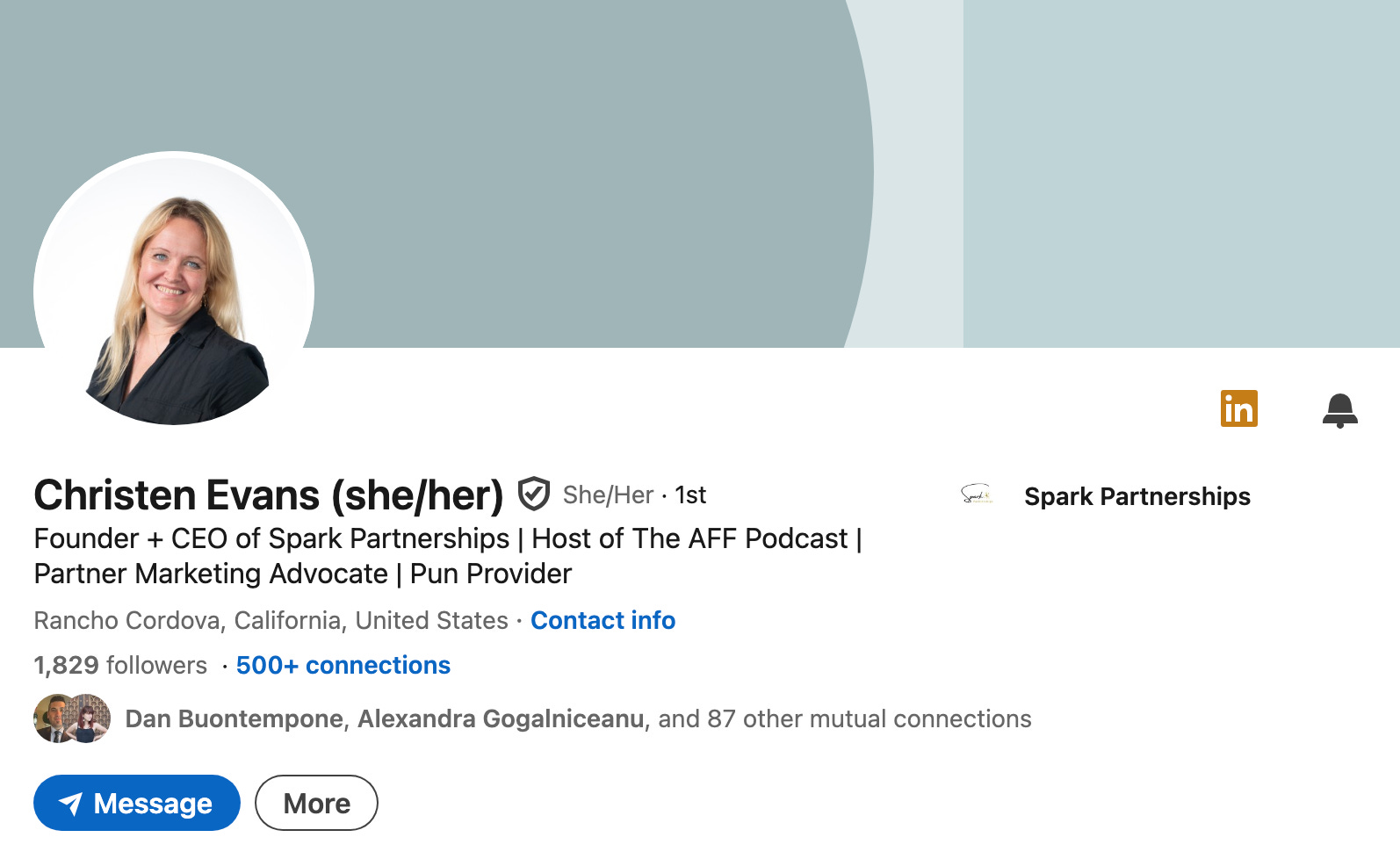
Tell us about yourself.
I grew up in Wyoming and have lived all over the country — Montana, Massachusetts, back to Wyoming, Kentucky, Texas and now in California. I attended Cape Cod Community College and got my Associates in Journalism. When I moved back to Wyoming, I worked in service and hospitality before eventually landing a job at my local newspaper as first a copy editor and later associate editor. It was during this time I landed a contributor role that would eventually lead me down the path to the affiliate industry.
I currently live in the Sacramento area with my husband, kid, 5 cats and French Bulldog. I love rainbows, sparkles, bourbon, Champagne, really good high-fives and Taylor Swift.
What are 3 fun facts about you?
I worked on a whale watch boat the summer after I graduated from CCCC.
I have a podcast, The AFF Podcast - All for Females in Affiliate and Partner Marketing.
I saw the Eras Tour twice — once in Santa Clara and once in Paris.
Can you share a bit about your background in the affiliate marketing industry?
Happily! Once I was promoted to Editorial and Accounts Manager at The Broke-Ass Bride, we began exploring affiliate as one of our monetization streams. I attended ShareASale (RIP) ThinkTank in 2013 in Denver and had a total lightbulb moment. I went back and applied what I learned to the blog and we doubled our revenue year-over-year for 3 years running. I also started working with other wedding bloggers during this time to help them implement affiliate into their monetization strategies — and serendipitously this was around the same time the Etsy affiliate program launched.
After the birth of my kid in 2016 I joined one of the agencies I was regularly working with as their publisher recruiter and did social media for the agency. I was there for 4 years, and by the time I left I was Senior Account Manager overseeing 35 of the 40 clients in the portfolio and had developed a team of 8.
From there, I worked in-house at a couple of brands, then stood up the affiliate division at a PR firm, where we launched 21 brands in Performance PR over the course of a year.
I left there at the very end of 2022, and launched Spark Partnerships less than a month later after some workshopping and very generous encouragement from friends in the industry.
I also served on the Board of Directors for the Performance Marketing Association for the last 6 years — I termed out this year and already miss it. During that time, I also served as President and Treasurer and actively participated in webinars, panels, white papers and more. I even got to represent the PMA at eTail in both Boston and Palm Springs as well as at AWIN Global ThinkTank in Portugal last year.
What’s something about your day-to-day that people might be surprised to learn?
I work in complete silence. I rarely ever have music or background noise (aside from my dog snoring and my cats being gremlins) while I’m heads down. And even though I work from home, I make a concentrated effort to get up, get dressed and look good … even if I don’t have meetings. It helps me get into the right mindset to work.
Tell us about yourself and your agency - what does “full funnel affiliate management” actually mean in practice?
Spark Partnerships is a boutique agency that focuses on small and emerging businesses who are primed for the affiliate space but need some strategy and guidance on the best practices. Two of our main tenets are Education and Empowerment, both for brands and for affiliate partners. The more people know, the better-positioned they are to be able to make the best decisions for their businesses. Often times we’re helping brands launch their new programs or taking over under-managed programs and helping propel them forward.
When we talk about full-funnel affiliate management, we’re looking at the entire customer journey and meeting consumers where they are — from discovery all the way through to conversion. This means focusing on brand awareness plays and the storytelling component that helps educate consumers on why a brand or a product is the solution to a problem they may have. Additionally, consumers have been so trained to look for deals, discounts and reward points that it’s important for brands to have ownership over those relationships in the space to push conversions while also ensuring brand alignment and messaging. This means we strategically engage media, review sites, content creators and select loyalty and coupon partners.
What are 3 tips you would recommend for publicists to have a productive Affiliate Agency / PR Agency relationship?
1. Take a minute to study affiliate marketing and what it truly is. There’s a lot of nuance with the relationships, and it can be very rising tides if done right, but remember that affiliate isn’t a channel — it’s a payment model.
2. The data tells the story. And not every placement is going to result in conversion data, but it will help build the brand awareness.
3. Be willing to be willing! Get your hands dirty with managing an affiliate program so you can see and understand the inner workings, including vetting applications, delivering reporting, exploring network capabilities and more.
How do you handle the conversation when a creator / influencer doesn’t deliver expected results?
It can be a bit of a letdown when a partnership doesn’t measure up, so the first thing to do is ensure expectations have been laid out beforehand. If the content doesn’t deliver the expected results, negotiate a makegood or see if they can work the product or brand into additional content. It’s also important to ensure audience alignment and intent before securing placement, but opportunities that don’t mete out aren’t necessarily a failure — good learnings can often come from underwhelming results.
What role are you seeing creators play today inside a program and how does that compare over the last say 5 years?
Creators have taken on so many different forms over the years. When I got started in the affiliate industry, as a blogger, we were creators. Then influencers were creators. Now creator is more of an all-encompassing term for anyone who creates content outside of review sites and media. They are and always will be one of the stronger foundations leading to brand credibility and authority as well as new customer acquisition.
How should publicists think about compensating creators differently from traditional editorial partners?
Hybrid fees can go a long way with creators. They’re putting in a lot of work without guaranteed outcomes, and they’re assuming all of the risk. By buying in and giving creators a secured fee up front with affiliate commissions and even performance bonuses, everyone takes on some of the risk and has buy-in to the relationship making it more equitable.
What makes a creator “high potential” from a revenue standpoint, beyond follower count? Do you use any third party vetting software outside of the network?
Follower count is not the metric I judge creators by. I look at their engagement, past brand partnerships and the metrics that resulted from those (creators should definitely be gathering this data for their media kits!) and what truly fits into their content seamlessly. I don’t really trust any third party software for this because we all know those numbers can be inflated. What works best is to have a good introduction call and gauge whether there’s genuine interest and alignment.
Have you seen small, consistent bonus structures drive long-term creator engagement more effectively than large CPAs?
Yes and no. I’ve been part of affiliate programs that have done the bonus structure really well over the years and have netted handsome returns for their partners, but large CPAs can also be incredibly incentivizing if it makes sense with the product pricing. A 35% CPA on a $20 product? Maybe not. But additional bonuses for every 20 sales? That could be interesting and potentially a much quicker payday for partners.
Outside of creating unique codes and commissioning them in network, are there any additional creator attribution protections you recommend when brands also work with coupon publishers and sub-networks are also in the affiliate mix?
I love Impact’s ability to have preferred partners, so when there are multiple affiliates in a clickstream, you can identify who you’d like to get credit over others.
Additionally, Shopify’s headless solutions with unique landing pages and the ability to bake discounts into the link creates a really cohesive experience.
At what point does it make sense to move a creator from pure affiliate to hybrid or paid partnership?
I think that to foster the evergreen aspect, a rev share or bonus structure should always be on the table. Flat fee payments should be leveraged for key brand moments including launches, brand campaigns, etc., while affiliate should be in play to drive consistent brand alignment.
What infrastructure must exist before scaling a creator affiliate program? There has to be a willingness to invest with not only product but some level of flat fee.
With affiliate, creators take on the majority of risk while doing the brand story work. If brand awareness with a path to conversion is the goal, then creators need to set up to be the full funnel — from discovery to education to conversion. Without a level of brand awareness and share of voice in the market, then it’s going to be an uphill battle for partners to drive those conversions.
If you were advising a PR team launching a creator affiliate strategy in 2026, what is the one structural decision they must get right from day one?
Attribution and commission structures will be key to success. Understand who is driving new customer acquisition and their role in the click stream. Reward partners based on the value of their role in conversions.
How can agencies get in touch with you if they want a hands off approach to affiliate management?
I’m always on LinkedIn, or feel free to reach out to christen@sparkpartnerships.com
Have questions? Would love to chat with you in Slack.
Did you know that our paid subscribers get access to a slack channel to chat about all things affiliate? Link below the paywall.
