What PR Misses About Google
A deeper look at how PR, affiliate, social, and search feed each other

Leading with HUGE news as Rakuten and Impact strike up a partnership. We have an interview with Impact team on Thursday, so more to come next week, but in case you missed it, catch up here.

That was a bit of a shocker to wake up to! Now onto our regularly scheduled programming….
There’s this quiet gap in how most of us think about marketing.
We sit in our lanes, whether that’s PR, affiliate, social, SEO, etc & we get really, really good at what we do. But what’s often missing is a deeper understanding of how all of these pieces actually work together. Not just in theory, but in practice. Not just “top of funnel vs. bottom of funnel,” but how one channel quite literally feeds the next.
Because the reality is that no channel operates in isolation anymore.
Kris had a client recently bring her on to manage more of the marketing funnel & Google was a big discussion. She realized how misunderstood it still is, especially for teams that don’t directly manage it.
So we went straight to someone who lives and breathes it.
Search is the only channel where someone is actively raising their hand. They’re not being interrupted. They’re not passively scrolling. They are looking 👀 with intent, curiosity, or need.
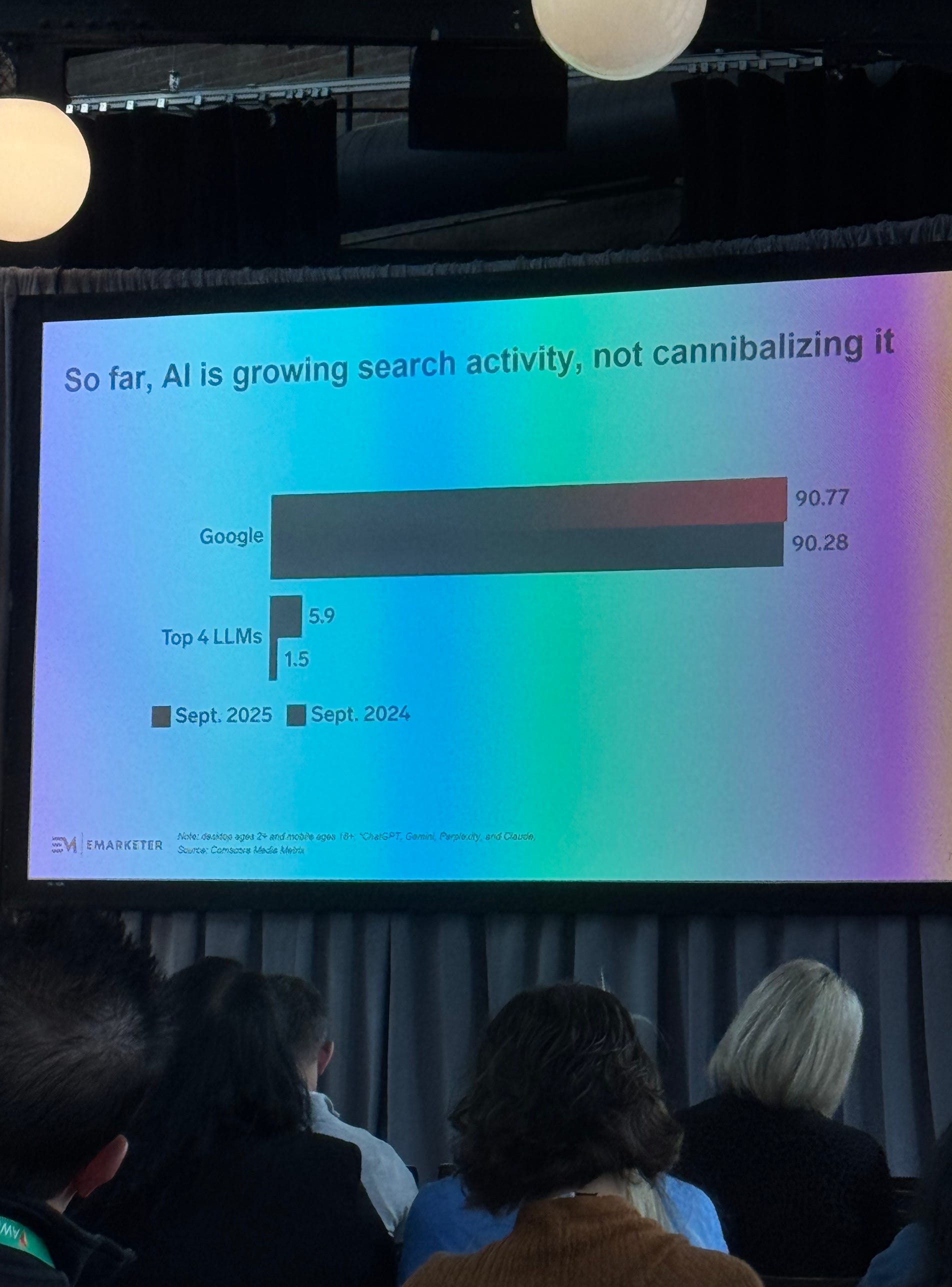
Google still reigns supreme, the below slide from the AI in Affiliate Marketing panel from ThinkTank Americas 2026 which was moderated by and featured research from EMARKETER with the rest of the panel including Giovanni Forner, Head of Emerging Accounts & LATAM Advertiser, Expedia Group, Lily Ray, the brilliant SEO strategist and founder of Algorythmic alongside Adrian Fagerlund, Co-founder of Linkby.
While the growth of AI is all anyone can talk about, and for good reason, people seem to skip over the fact it’s no where near the adaptation of Google as it relates to search. Not even close. So while yes, learn, invest and figure it all out, but don’t forget the tried and true methods when they’re not gone and they set the foundational layer for your brands growth and current visibility.
Ensuring you stay up to speed on ALL channels that impact yours is critically important. AKA do all the things ; )
With over 15 years of experience in marketing and media, TJ founded Vine Street Media to offer businesses of all sizes a more strategic and personalized approach to digital marketing. Throughout his career, TJ has seen firsthand how many agencies miss the mark by focusing on generic solutions, which is why he built Vine Street Media to prioritize tailored strategies and clear, actionable insights.
Tell us why a brand needs to have a Google Ads manager!
While I completely understand the DIY approach and encourage it, it’s a deceivingly layered platform that is challenging to navigate. One missed checkbox during campaign setup, and you’re spending 90% of your budget on Display ads. If you have a smaller account in Google’s eyes (<$120k/yr), your “support” team is 3rd party company masked as Google (xwf is in their email address) whose primary goal is for you to increase spend. Even when you get to a support person in New York or San Fran, they’ll just double down on their agenda. An ideal ad manager will care less about your spend and more about your business objectives and field those conversations to look out for your best interest.
How long have you been in the industry and what makes you stay?
I ran my first campaigns in 2006, 20 years ago! My career in the field officially started 15 years ago. I think what has kept me in Search is how it’s fundamentally different than any other digital channel. It is the only truly behavior-based medium. People have made a decision to physically look something up out of their own need or curiosity. Though it’s influenced by outside sources, those sources were pushed upon them, unlike a personal search.
Give us a few cases where a brand thought the program was being managed, you got in there & had a WTF moment.
Most audits I run, I generally have this moment. Depending on how an account is set up, you can tell their level of expertise. What I think is most disheartening, though, is when I look at the changelog and see nothing’s been done for months, and performance is poor. That’s a business being blatantly taken advantage of, and I find that morally wrong to do to someone.
We understand that everything needs to work together in a marketing funnel - PR, social, google, SEO, a website that converts - do you think Google still needs to have a heavy focus when it comes to the marketing funnel?
I’m mostly onboard with the theory that Google will be a larger piece of the funnel within the next 2-3 years. As we move to a site-less experience by interacting more with AI, there will be less of a place for Display publishers. SEO will still be key, and AI will need to pull information from sites. Then externally, we’re so integrated with social media, it and the combo of PR will be fundamental. But sites like WebMD are at risk of major revenue losses. If you can find the medical content you want in Gemini without clicking, why would a brand pay for impressions on a website?
If a marketing team is new to reading Google Ads, what are the top 3 things you would say are the ones to really focus on understanding.
I think brands want to focus on ROAS and if they are/aren’t satisfied with the number. My top 3 are less about the platform and more about how to get the most out of your ads team
Clearly define audience buckets and share them or explore what they could be with your ads manager. You’re going to know your customers best, ad managers then know how to best leverage this data.
Be receptive to how Google Ads can quickly expose “weak points” and turn them into opportunities. For instance, CTR may be double benchmark, but ROAS is <1x. Going back to behavior, the right audience is searching and clicking, but what aren’t they getting on the page to push them over the edge? Should the edge be a sale or a sign-up?
Google is moving towards signal-based marketing, and now becoming efficient takes time. Google trained advertisers to think, bid high, get #1 positioning, the sales flow! This, unfortunately, couldn’t be further from the truth in 2026. Google has so much data on anyone with a Gmail account; those previously mentioned audiences are becoming more important than keyword selections.
Is Google management an umbrella approach for each brand in the sense that you would say if you’re a DTC brand you need a GA manager?
I think the hard truth is, it’s becoming a pay-to-play platform. If you’re not spending at least $100/day, there isn’t much to optimize, and you can realistically give it a run without a manager. Once you pass that threshold, you’re now into multi-campaign management. It’s also important to keep in mind that Google is agnostic to DTC, B2B, etc. You have every sub-channel to choose from in the platform: Traditional Search, Shopping, Display, Gmail, Discover and YouTube. A seasoned GA manager can cover them all!
How does GA management go hand in hand with PR/Affiliate Marketing efforts?
The traditional answer that comes to mind, those are push marketing and search is pull marketing. We need the push to get people to search. If they’re not seeing it, they won’t research what they like or what their favorite influencer likes/recommends. Outside of this, I see Google making pushes where this becomes a blended effort. Google is trying to use YouTube Shorts as its answer to TikTok and IG Reels. Right now, I think it’s an underutilized channel that’s massively growing. Put content here!
Have questions? Jump in our paid channel in slack and let’s dive in! Not yet a subscriber? We’d love to have you help support these interviews.
